
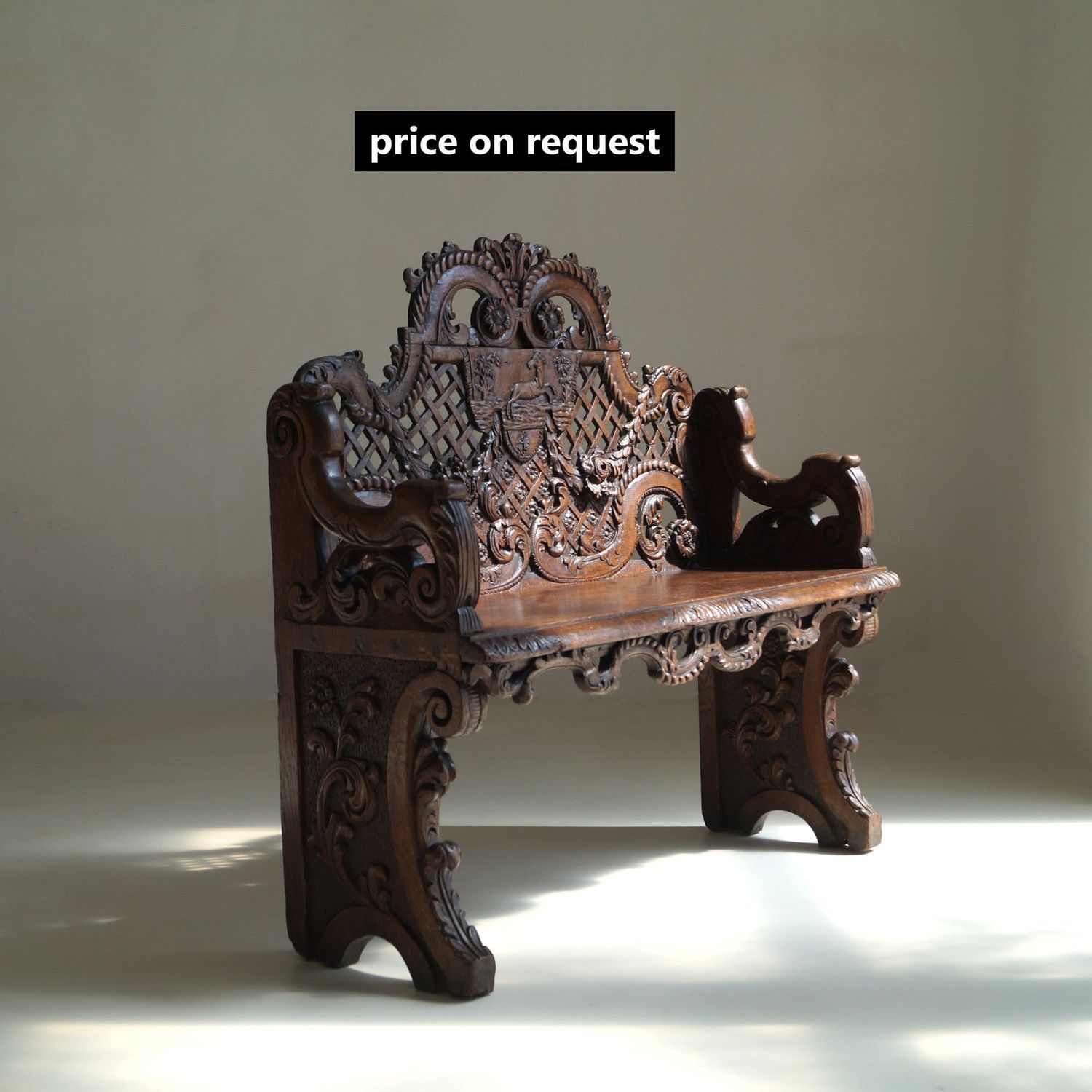
Rare Dutch Baroque Hall Bench after Daniel Marot, circa 1720
€ 0,00
In stock: 1 available
Product Details
Price on request
An exceptionally rare Dutch Baroque hall bench, or halbank, dating from circa 1720 - 1740, executed in solid carved oak and closely following the decorative language associated with Daniel Marot (1661–1752). A highly unusual survivor from the Dutch Baroque interior - sculptural and exuberantly carved, yet exceptionally intimate in scale.
The hall bench (halbank) is a distinctly Dutch type of furniture that became fashionable around 1700, when the entrance halls of prosperous Dutch houses developed into increasingly important representative spaces. In the grand canal houses and patrician townhouses of cities such as Amsterdam, these halls were often furnished quite sparingly, allowing a small number of impressive objects, such as a standing clock, console or richly carved bench, to become part of the architecture itself.
The finest hall benches were therefore conceived more as sculptural elements for an interior than as functional seating. Their elaborate carving echoed the carved woodwork, stucco decoration and architectural ornament found elsewhere in the house. Surviving examples are rare, particularly those retaining such an extensive and sophisticated carved decoration.
The development of this type of furniture is closely connected with the enormous influence of Daniel Marot, the French Huguenot architect, engraver and designer who settled in the Netherlands and became court designer to Stadholder-King William III of Orange. Marot introduced the grandeur and ornamental vocabulary of the French Louis XIV court to the Netherlands, adapting it to Dutch architecture and interiors. His designs for furniture, interiors, architecture and gardens circulated widely through engravings and provided an important source of inspiration for Dutch craftsmen well into the 18th century.
This particular bench is best described as “after Daniel Marot”, referring to this strong stylistic and ornamental connection.
The design is remarkably elaborate. The high pierced back is constructed around a strongly symmetrical composition of latticework, sweeping C- and S-scrolls, flowers, acanthus leaves, scrolling foliage and deeply carved ornamental strapwork. At its centre is a charming figurative panel depicting what appears to be a leaping stag or deer in a landscape, positioned above a small shield. Large scrolling elements rise above and around this central motif, while carved rosettes and foliage punctuate the open latticework.
The sculptural treatment continues throughout the bench. The arms sweep forward in powerful scrolling curves, the seat rail is carved with continuous foliage, and the pierced apron below forms an almost lace-like sequence of scrolling ornament. Particularly striking are the broad panelled front supports, each decorated with a large flowering foliate motif carved in relief against a textured ground and framed by a dramatic inward-curving scroll.
Despite the extraordinary amount of decoration, the bench has unusually modest proportions. At only 98 cm wide, it is considerably smaller than the monumental hall benches normally associated with this tradition, yet it incorporates virtually all of their architectural and ornamental vocabulary.
This compact scale is one of its most intriguing characteristics. It strongly suggests that the bench was made as a specific commission for a particular position within a sophisticated private interior, rather than as a conventional large hall bench. It possesses the visual presence of a much larger piece while occupying remarkably little space.
Dimensions: H 96 × W 98 × D 36 cm | H 37.8 × W 38.6 × D 14.2 in
Literature:
The Schermerhorn Collection: Important Dutch Furniture and Sculpture, Christie’s Amsterdam, 29 September 1999, pp. 8–14, with an essay by Amjad Rauf discussing the history and development of the Dutch hall bench.
Koen Ottenheym, Willem Terlouw and Rob van Zoest (eds.), Daniel Marot: Vormgever van een deftig bestaan. Architectuur en interieurs van Haagse stadspaleizen, Zutphen: De Walburg Pers, 1988.
| Creator | after Daniel Marot (1661–1752) |
|---|---|
| Design Period | 1700–1710 |
| Production Period | 1720-1740 |
| Country of Manufacture | Netherlands |
| Identifying Marks | |
| Style | Baroque, Rococo, late Louis XIV, Maximalist, Eclectic |
| Detailed Condition | Wear consistent with age and use. Wear according to 300 years of age - wear on the leg ends |
| Restoration and Damage Details | Back has been reinforced with wooden slats (probably early 1900s). |
| Product Code | 0602 |
| Materials | Oak |
| Color | Brown |
| Width | 98 cm |
| Depth | 36 cm |
| Height | 96 cm |
| Seat Height | 45 cm |
| Weight Range | Medium — Between 15 kg and 20 kg |
Save this product for later
Display prices in:
EUR